
Criminal Court Records in Dodge County
A criminal court record is the court case file maintained by Dodge County District Court and Court Administration after a prosecutor files a criminal accusation. It is not the same thing as a sheriff arrest report, an in-custody roster entry, or a background-check result. The court file tracks what happened in District Court: the charge, court dates, hearings, motions, plea, disposition, sentence, warrants noted in the case, and any public documents available through MCRO.
Dodge County District Court has original jurisdiction over criminal and traffic cases filed in Dodge County. Minnesota uses a unified District Court trial level, so misdemeanor, gross misdemeanor, felony, and many citation-based records route through District Court systems when they become court cases. The Dodge County Attorney prosecutes county criminal offenses except municipal ordinance violations, and the County Attorney's Office is at 22 6th Street East, Dept. 91, Mantorville.
The Minnesota BCA Public Criminal History Search is the statewide criminal-history source shown below.
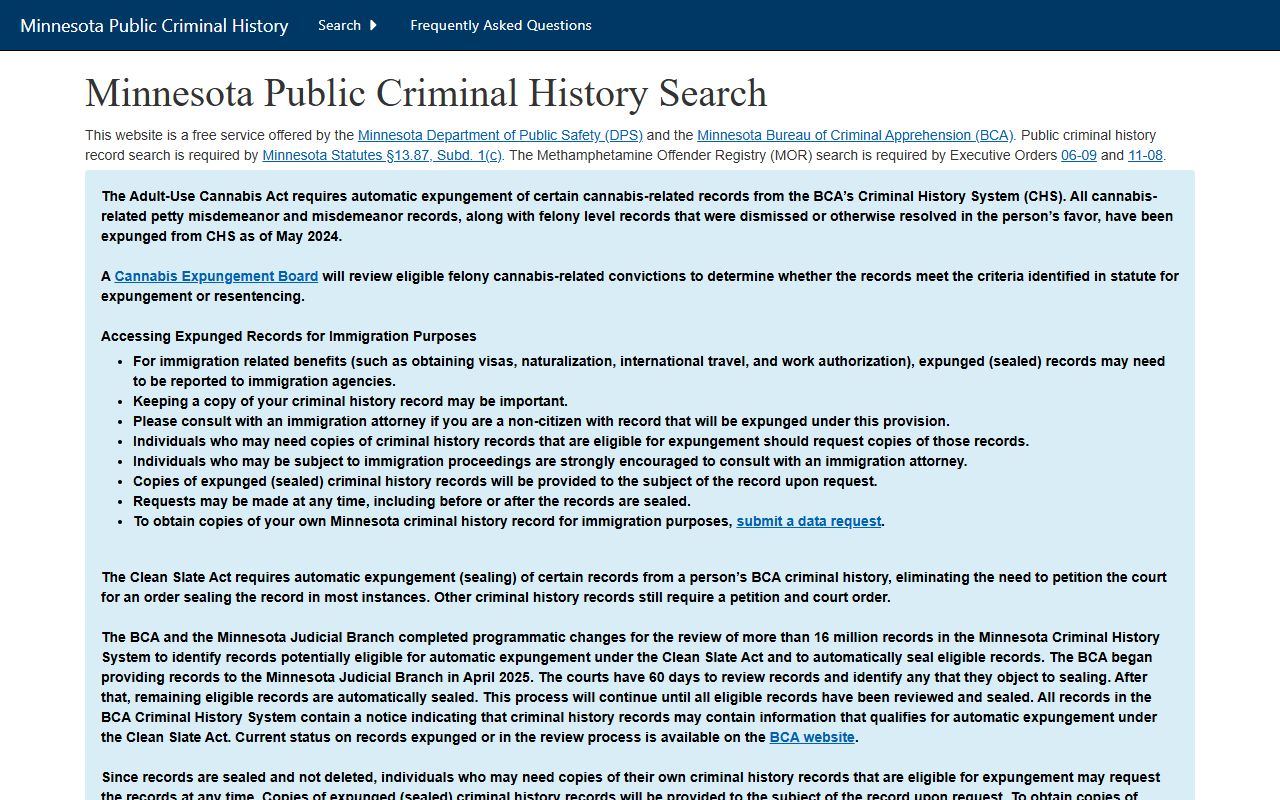
BCA criminal history is the official public background-check route; MCRO is for court case research and is not certified for background checks.
How to Search Dodge County Criminal Court Records
Use MCRO Case Search for public Dodge County District Court criminal cases. The most precise searches use a court file number, but name searches can work when combined with date of birth, filing-date filters, Criminal case category, case status, and the Dodge County court-location filter. A criminal case number may use the CR category, such as 20-CR-26-188 in the Dodge public calendar examples.
- Open MCRO Case Search, accept the terms, and choose Name, Case Number, Citation Number, or Attorney.
- For a defendant-name search, enter the legal name and use date of birth or filing-date filters if known.
- Select the Criminal case category and choose Dodge County under specific county court locations.
- Open the case result and review the Register of Actions, charge entries, hearings, bail or warrant notes, public documents, disposition, sentence, and financial obligations.
- Use MCRO Document Search only when the case number is known and public documents are available remotely.
- Request certified copies from Dodge County Court Administration when an official court copy is needed.
For jail status, use the Dodge in-custody list through inmate records. For active warrants, use the Sheriff's warrant list and warrant records. For the charge-focused arrest-to-filing pathway, use arrest records and court charges.
Stages of a Criminal Case
The criminal court record grows as the case moves through District Court. Arrest information can exist before filing, but the court case begins when a complaint, citation-based charge, or other charging document is filed. Hearings and filings then appear in the Register of Actions if public. Not every case reaches trial; many resolve through dismissal, plea, amended charge, diversion-like outcome where available, or sentencing after a conviction.
Case flow: Charges Filed › First Appearance / Arraignment › Pretrial / Motions › Plea or Trial › Disposition › Sentencing
| Stage | What Happens |
|---|---|
| Charges Filed | The prosecutor files the accusation in District Court, creating the court case and charge record. |
| First Appearance / Arraignment | The defendant appears, charges are addressed, release or bail conditions may be considered, and plea procedure begins. |
| Pretrial / Motions | Parties address evidence, scheduling, discovery, suppression, amendments, settlement, and other case-management issues. |
| Plea or Trial | The case resolves by plea, court trial, jury trial, dismissal, acquittal, or another disposition recognized by the court record. |
| Sentencing | After conviction, the court enters jail, prison, probation, fines, fees, restitution, conditions, or other sentence terms. |
What a Dodge County Criminal Court Record Shows
Criminal case records can show both summary fields and individual docket entries. The available online view depends on public-access rules, the age of the document, case type, and whether a document is remotely accessible. Public documents filed on or after July 1, 2015 are more likely to be available online for major and minor criminal case types, but courthouse access and certified-copy requests remain important for official records.
| Field | What It Shows |
|---|---|
| Case Number | District Court file number, commonly with CR for criminal cases. |
| Defendant | Name and party role of the person charged. |
| Charges | Offense title, statute, severity level, date filed, and later amendments or dismissals when public. |
| Hearings | First appearance, arraignment, pretrial, plea, sentencing, motion, review, or trial settings. |
| Plea | Formal response or plea outcome if entered and public. |
| Disposition | Current or final result for the charge or case, including dismissal, conviction, acquittal, or other outcome. |
| Sentence | Jail, prison, probation, fines, restitution, conditions, or other sentence terms when entered and public. |
| Warrants / Bail | Public case entries related to warrants, failure to appear, bail, bond, or release conditions. |
Charges vs. Convictions
A charge is an accusation filed with the court. A conviction is a result after a guilty plea, guilty verdict, or other conviction event recognized by the court. A Dodge County criminal court record may show charges that were pending, amended, reduced, dismissed, or resolved without conviction. Reading only the charge name can misstate the outcome of the case.
| Charge | Conviction | |
|---|---|---|
| Stage | Accusation after filing | Final or entered court outcome |
| Proof level | Based on probable cause or charging decision | Based on plea, verdict, or judgment |
| Can change | May be amended, reduced, dismissed, or added | May be appealed, corrected, vacated, or later expunged if eligible |
| How to read | Check current charge status and docket events | Check disposition and sentence entries |
Reading Dispositions and Sentences
Disposition is the current or final outcome of a charge or case. It may show dismissed, guilty, not guilty, acquitted, convicted, continued, or another status depending on the entry. Sentencing entries should be read separately from charge entries because a person may face several charges from one arrest, and each charge may resolve differently. Financial entries can include fines, fees, costs, restitution, and payment status.
The Minnesota Judicial Branch public defender information source shown below explains appointment options for people facing possible jail time.
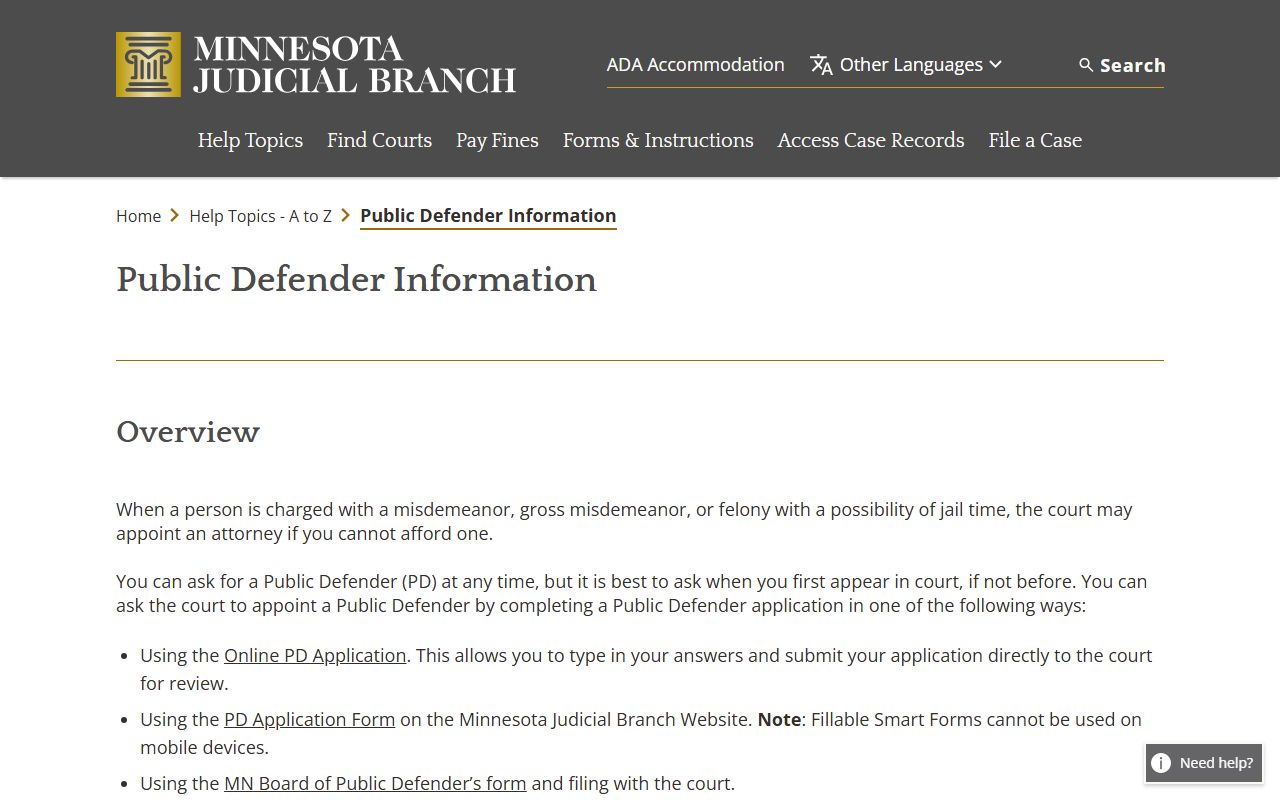
Public defender eligibility is a court process, and the applicant cannot choose the specific assistant public defender if counsel is appointed.
Sealed vs. Expunged Records
Minnesota expungement generally seals qualifying criminal records from public access; build content should not describe it as erasing every trace of the record. Chapter 609A is the main criminal expungement law, section 609A.015 addresses automatic expungement for certain qualifying records, and section 609A.02 lists grounds and limits for expungement orders. A judicial officer usually makes the final decision unless automatic expungement applies.
The Minnesota criminal expungement chapter source is shown below.
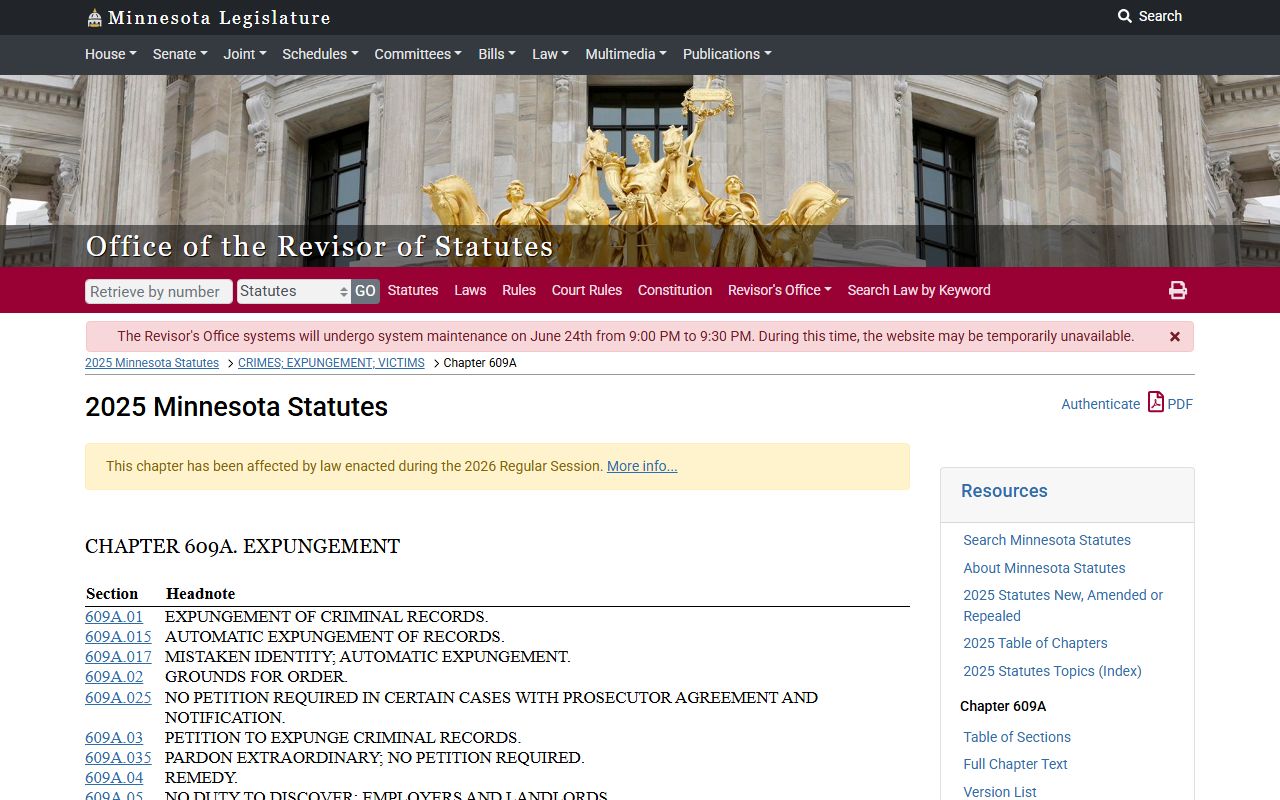
Chapter 609A is the starting point for understanding which public criminal court records may be sealed and which limits remain.
| Sealed | Expunged | |
|---|---|---|
| Public visibility | Hidden from ordinary public access by order or rule | Sealed under expungement authority, including some automatic processes |
| Legal effect | Access limited to authorized users or court order | Disclosure prohibited except by court order or statutory authority |
| Eligibility | Depends on record type and court rule | Depends on chapter 609A, 609A.015, 609A.02, and case facts |
| Practical limit | Does not make all agencies or private databases change automatically | May leave law-enforcement, licensing, immigration, or sentencing uses available under law |
The automatic expungement statute and grounds for expungement statute are shown in the following images.
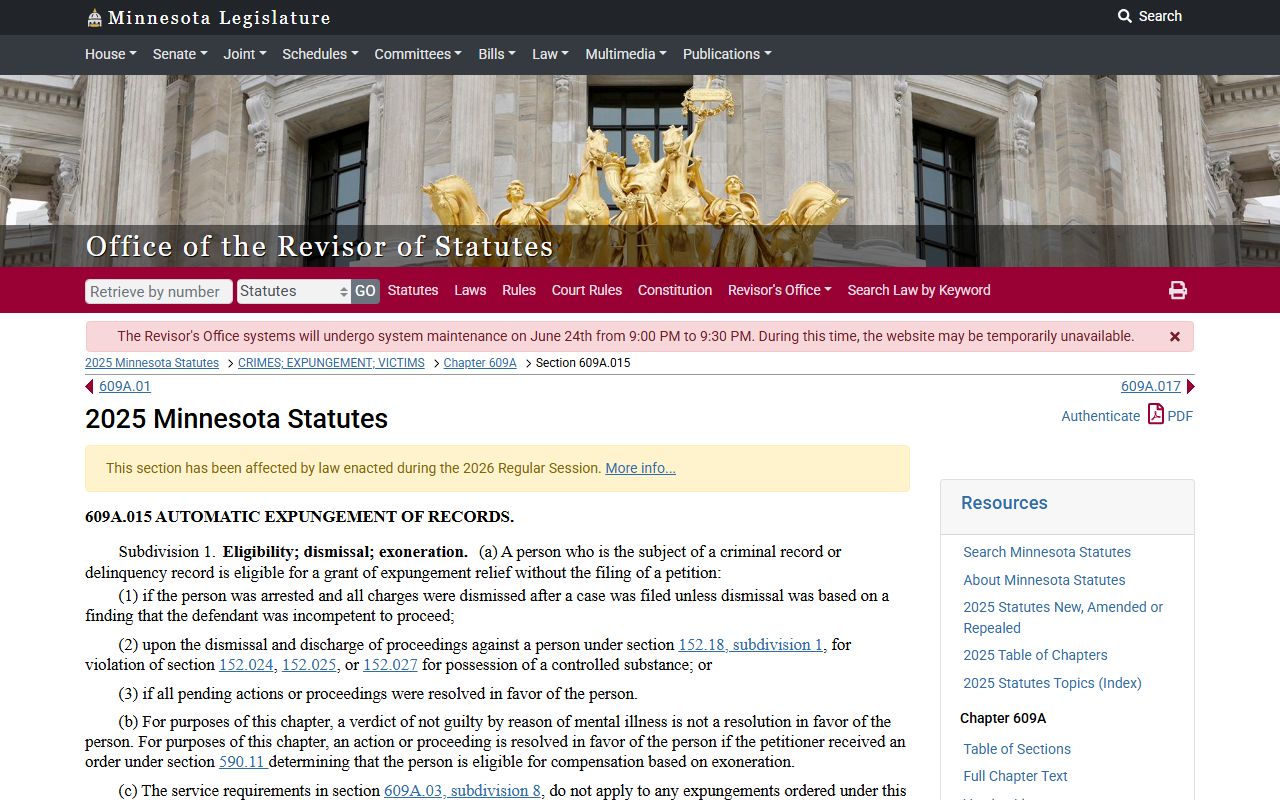
Automatic expungement applies only to qualifying records and should not be assumed for every dismissed or old case.
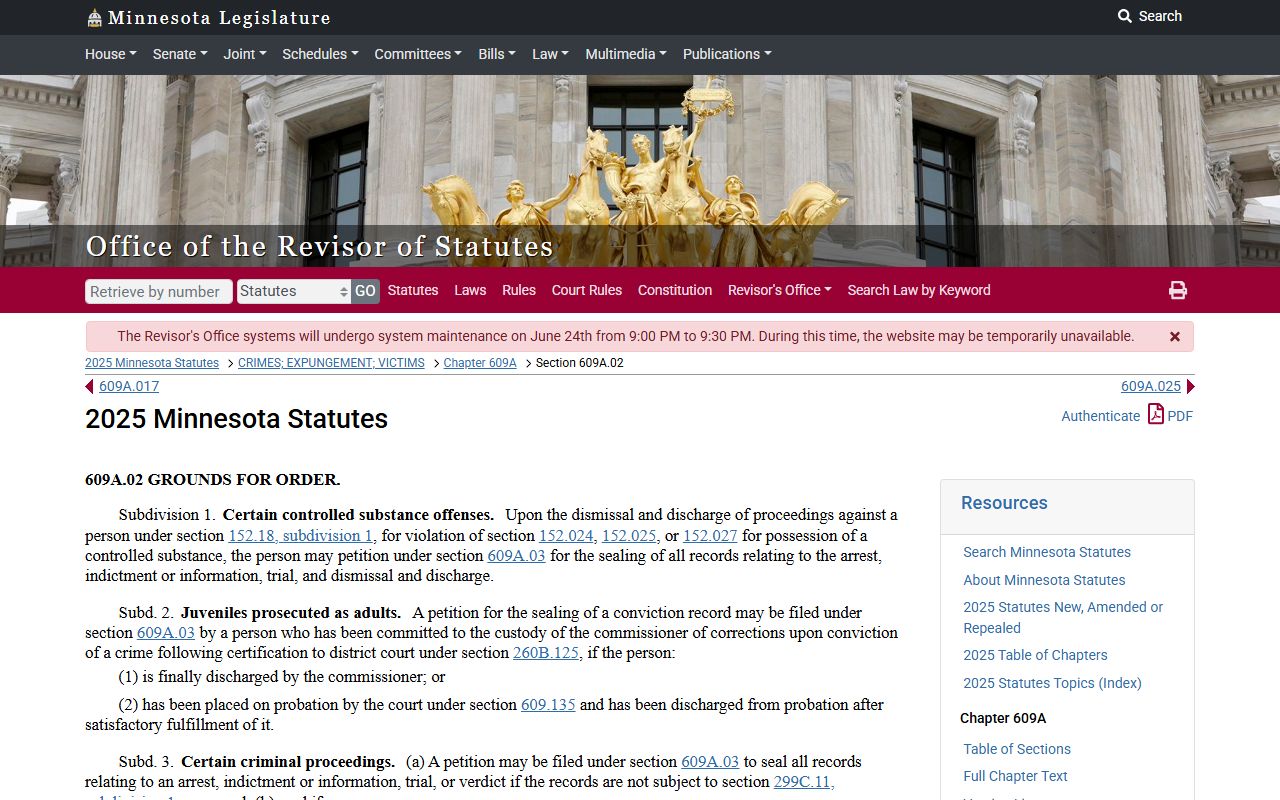
Section 609A.02 is the source for many petition-based grounds and limits, including offenses that may not qualify.
Public Access to Criminal Court Records
Criminal court records are governed by the Minnesota Rules of Public Access to Records of the Judicial Branch. Sheriff arrest, incident, and investigative data are governed separately by Minnesota Statutes section 13.82, and corrections or detention data are governed by section 13.85. That division matters in Dodge County because the Sheriff's Office may hold an arrest report, the in-custody roster may show booking status, and District Court may hold the complaint and disposition.
Key Statutes:
Minn. R. Pub. Access 4 identifies which Judicial Branch case records are publicly accessible and which are not.
Minn. Stat. 13.82 governs law-enforcement data, including arrest and investigative data that may be limited while active.
Minn. Stat. ch. 609A governs criminal expungement and sealing of qualifying records.
Background Check Considerations
MCRO terms direct background checks to the Minnesota BCA Public Criminal History Search rather than MCRO. A court case record may show allegations, pending charges, dismissed charges, or documents that are not suitable as a complete criminal-history report. A public criminal-history search may also differ from a complete court search because the systems answer different questions and have different reporting rules.
The Minnesota online public defender application is shown below.
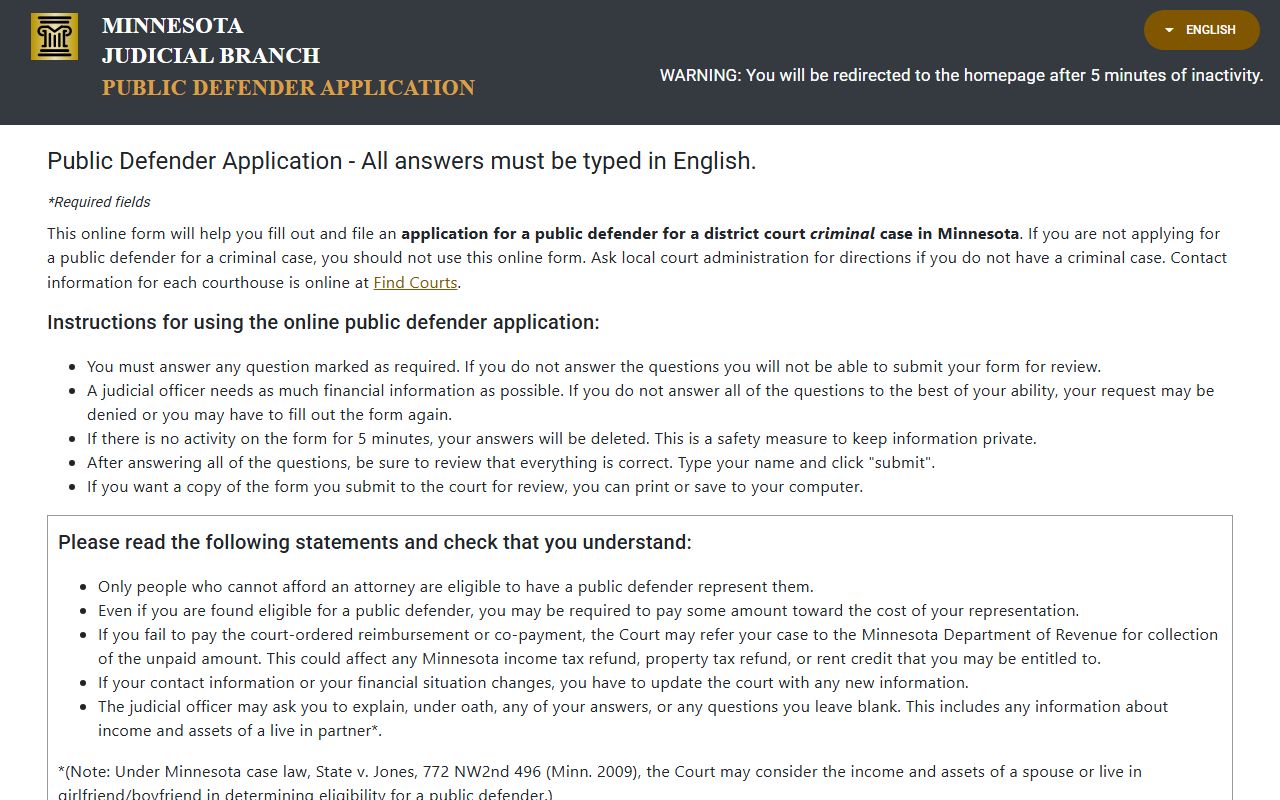
People charged with a misdemeanor, gross misdemeanor, or felony carrying possible jail time may ask the court to appoint a public defender if they cannot afford counsel.
Important: This site is not a consumer reporting agency and cannot be used for FCRA-regulated screening decisions.
Restricted Criminal Court Records in Dodge County
Restricted criminal-related records can include juvenile matters, sealed or expunged cases, personal identifiers, protected private data, and records withheld by court rule. MCRO does not display every public courthouse record remotely, and public courthouse terminals may differ from internet access. Cases under active law-enforcement investigation may also have sheriff records withheld even while a court case or public hearing entry exists.
Dodge County Court Administration handles court copies at 22 6th Street East, Dept. 12, Mantorville, MN 55955-2220, phone 507-624-7010. The Sheriff's Records Department handles law-enforcement records and requires photo identification for private data; its records email is dcso.records@dodgecountymn.gov. Public defender contacts for Dodge County route through the Third District Management Office in Rochester, 206 South Broadway, Suite 500, phone 507-285-7370.