
Dodge County District Court Overview
Dodge County District Court has original jurisdiction over civil, family, probate, juvenile, criminal, and traffic cases filed in Dodge County. It is the place where filed criminal charges become court cases, where divorce and family matters are processed, where probate estates and guardianships are opened, and where civil, conciliation, traffic, and petty matters enter the state trial-court system.
The court operates at the Dodge County Courthouse in Mantorville and is part of Minnesota's Third Judicial District. Court Administration handles local case management for traffic, civil, family, criminal, juvenile, and probate divisions from filing through disposition. The official Dodge County District Court page is at mncourts.gov.
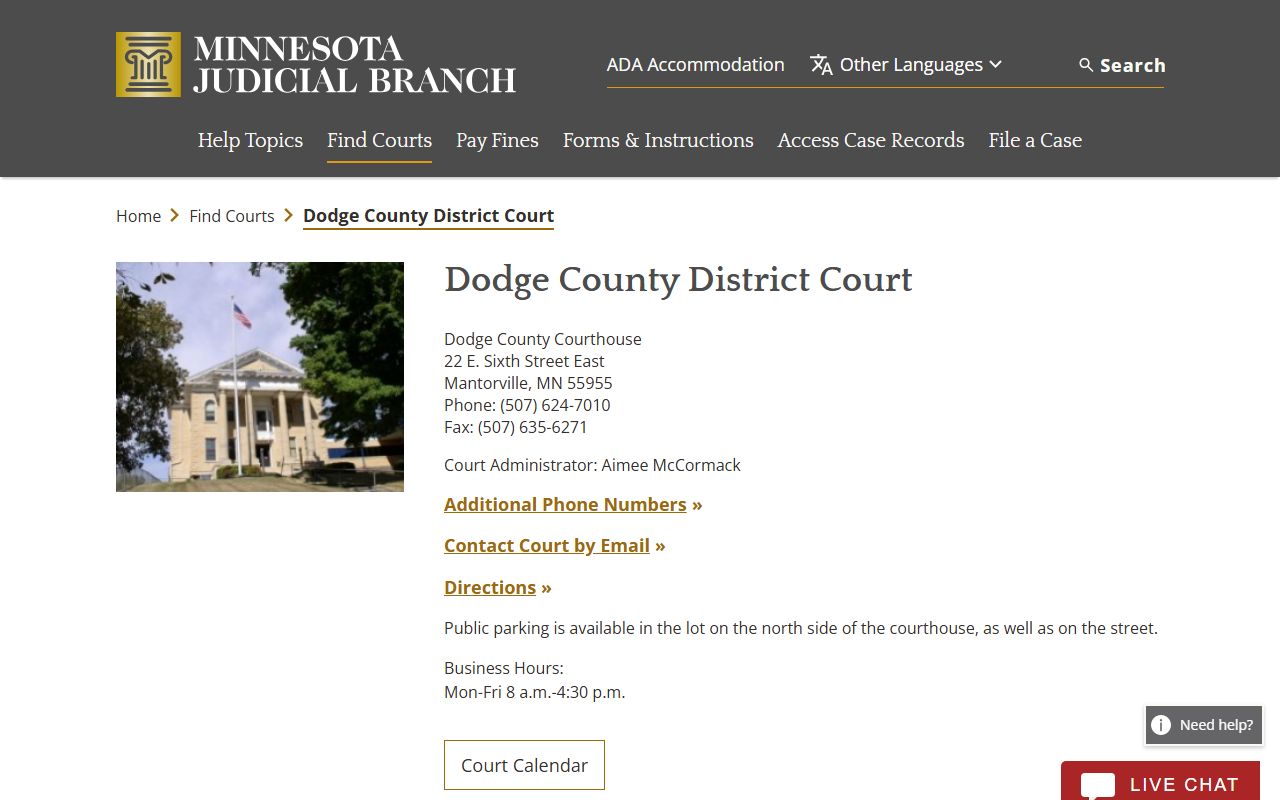
The Judicial Branch page supplies the courthouse address, local phone, Court Administrator name, business hours, calendar link, quick links, and jurisdiction statement used for Dodge County District Court access details.
List of Dodge County District Court Offices
Dodge County does not have multiple numbered district courts. It has one county District Court location with case divisions administered locally and a regional Third Judicial District administration layer that does not hear cases itself. The table separates court-record, administrative, appellate, and specialized statewide court roles so users do not send records requests to the wrong office.
| Court / office | Role | Address | Phone |
|---|---|---|---|
| Dodge County District Court | Trial court for civil, family, probate, juvenile, criminal, and traffic cases | 22 E. Sixth Street East, Mantorville, MN 55955 | (507) 624-7010 |
| Dodge County Court Administration | Local case management, certified court copies, filing and calendar support | 22 6th Street East, Dept. 12, Mantorville, MN 55955-2220 | 507-624-7010 |
| Third Judicial District Administration | Regional administration over 11 Southeast Minnesota county district courts | District-level office, not a case-hearing court | Use county court links |
| Minnesota Court of Appeals | Intermediate appellate court for most appeals from District Court | State appellate system | State court contact routes |
| Minnesota Supreme Court | Highest state court, statewide rules, attorney regulation, final review | Minnesota Judicial Center, St. Paul | State court contact routes |
District Court vs. County Court vs. Justice Court
States such as Texas use county courts and justice courts, but Dodge County follows Minnesota's unified District Court model. Municipal ordinance violations may involve municipal prosecutors, yet court records still route through District Court or Minnesota Judicial Branch systems once filed as court cases. Conciliation Court is a District Court division for smaller civil disputes, not a separate Dodge County courthouse.
| District Court | County Court | Justice / JP Court | |
|---|---|---|---|
| Civil Limit | General civil and conciliation division jurisdiction under Minnesota District Court | Not a separate Dodge County trial court | Not used in Dodge County |
| Criminal Jurisdiction | Felony, gross misdemeanor, misdemeanor, petty, traffic, and related filed cases | Not a separate criminal court | Not used in Dodge County |
| Family Cases | Yes, including divorce, custody, child support, and related matters | No separate county court channel | No |
| Probate Cases | Yes, through the Probate Division of District Court | No separate probate court | No |
How a Case Moves Through the Dodge County System
Case flow depends on the case type, but the local path begins with filing in Dodge County District Court when venue belongs in Dodge County. Court Administration opens and manages the case record, hearings appear through the public calendar or MCRO when public, and appeals move into the statewide appellate structure. Criminal arrest records remain sheriff or law-enforcement records until a prosecutor files court charges.
| Stage | What happens in Dodge County | Record source |
|---|---|---|
| Filing or charge | A complaint, petition, citation, probate application, or prosecutor filing opens the District Court case. | MCRO and Court Administration |
| Scheduling | The case receives hearings such as first appearance, pretrial, motion hearing, court trial, review, plea, or sentencing when applicable. | Dodge court calendar and MCRO Hearing Search |
| Orders and docket entries | The Register of Actions tracks filings, hearings, notices, orders, judgments, warrants, and financial obligations when public. | MCRO Case Search or courthouse access |
| Certified copy or appeal | Certified copies come from Court Administration; appeals move into the Minnesota Court of Appeals or Supreme Court path. | Court Administration and appellate courts |
Criminal flow: Arrest or citation › Prosecutor filing › First appearance › Arraignment or plea stage › Pretrial hearings › Trial or resolution › Sentencing › Appeal.
Civil flow: Complaint or petition filed › Service and answer › Motions or scheduling › Discovery or settlement process › Trial or court decision › Judgment › Appeal.
Probate flow: Application or petition › Appointment of personal representative when granted › Inventory and asset protection › Debt payment › Distribution › Closing documents.
Civil, Family, and Criminal Divisions
Civil cases include lawsuits, money judgments, conciliation matters, evictions, and related orders. Family cases include divorce, custody, parenting time, child support, and paternity. Criminal cases include the filed court case after charges are brought by the prosecutor, while sheriff booking reports and incident reports remain separate law-enforcement records.
Probate covers estates, wills, trusts, guardianships, and conservatorships. Traffic and violations bureau matters use District Court systems and may appear by citation or case number. Juvenile, domestic abuse, harassment, and mental-health matters have stricter remote-access limits under Minnesota public-access rules, so a missing MCRO result does not always mean there is no court action.
Dodge County's public court calendar is also a District Court product, but it is not the full case file. The researched calendar fields include party name, hearing location, hearing date, time, judicial officer, hearing type, connection type, and case number. The calendar is posted at 7 a.m. each business day and updated hourly, while printed courthouse calendars remain the most current daily schedule.
Third Judicial District
Dodge County belongs to the Third Judicial District. The district includes Dodge, Fillmore, Freeborn, Houston, Mower, Olmsted, Rice, Steele, Wabasha, Waseca, and Winona counties. The district administration page states that it is an administrative office over county district courts and does not hear cases itself. Case questions for Dodge County matters therefore belong with Dodge County District Court or Court Administration.
The Third Judicial District page identifies twenty-four judges and one referee serving the district, with Hon. Christine A. Long as Chief Judge, Hon. Christa M. Daily as Assistant Chief Judge, and Shelley Ellefson as Judicial District Administrator. The official district overview is at mncourts.gov.
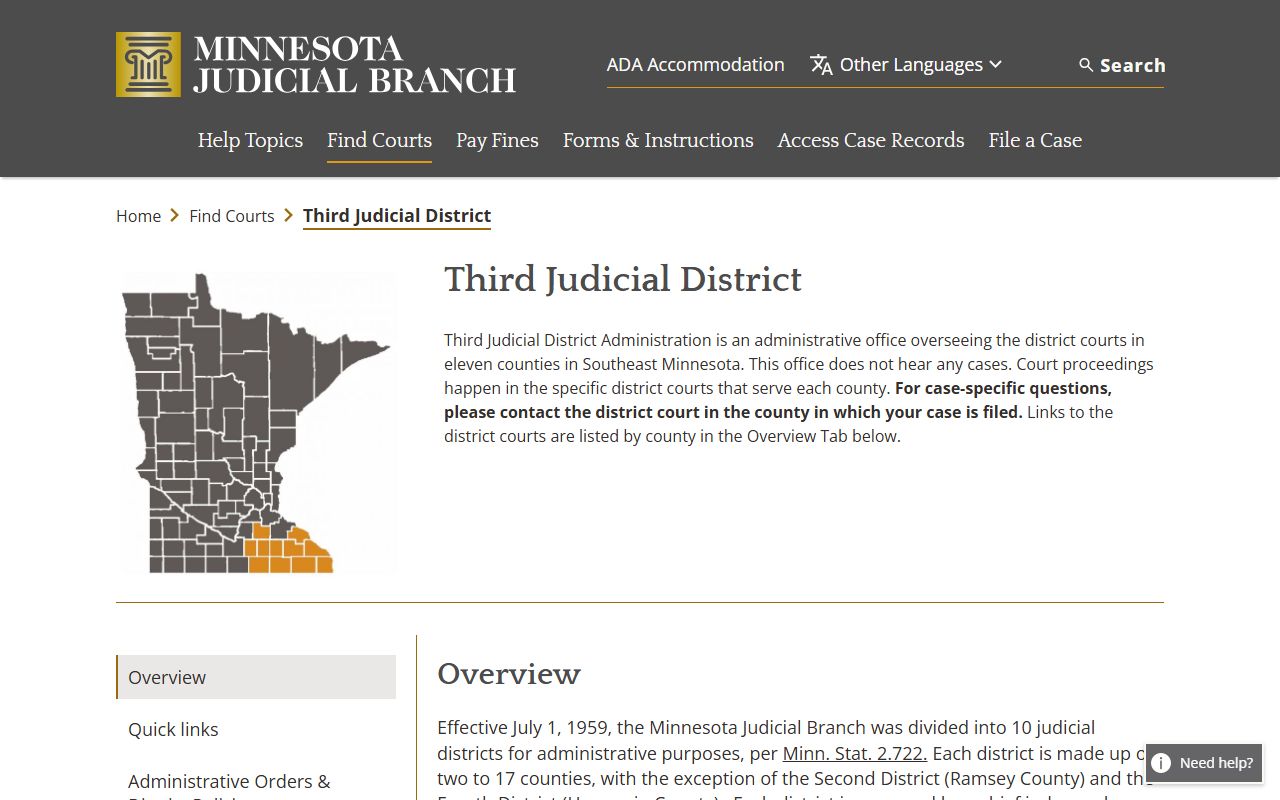
The district context helps explain why some programs, forms, and administration are regional, while filings, calendars, and certified copies remain tied to the county court where the case is filed.
Courthouse History and Security
The Dodge County Courthouse at 22 E. Sixth Street East is an active courthouse and historic county building. The county courthouse history PDF says construction of the limestone courthouse began in 1865 and was completed in 1871. It describes 40-inch-thick walls, windstorm roof repairs in 1890, additional office space added in 1990, and the courthouse as the oldest working courthouse in Minnesota.
The courthouse history also explains why several record-related offices sit close together but do not perform the same function. The Sheriff's Office page says DCSO is located in the east wing of the courthouse, while Court Administration and District Court are in the screened Public Safety area. Recorder/Land Records is nearby at the Government Services Building, 721 Main Street North, rather than at the District Court counter. A visitor seeking a certified court order, a sheriff incident report, and a marriage certificate may need three different channels even though all are Dodge County records.
Security is a practical court-day issue. Dodge County implemented enhanced building security and court-safety procedures in 2016, including weapons screening at the entrance to the Public Safety area. The screened area includes the Sheriff's Office, Probation, County Attorney's Office, Public Defender's Office, Drug Court, Victim Services, Court Administration, and District Court. All court hearings are staffed with licensed armed deputies.
The county courthouse security page at dodgecountymn.gov lists prohibited items and explains that security will not hold them for visitors.
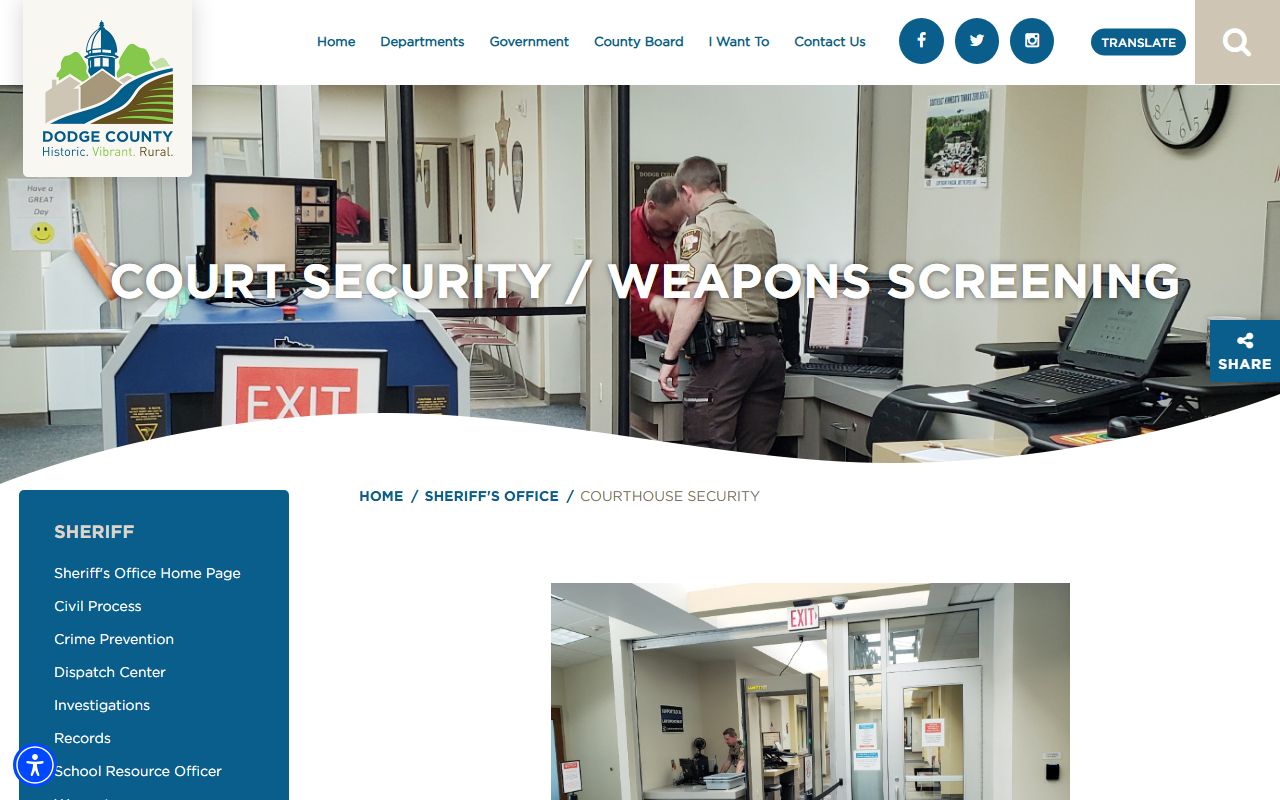
Visitors should leave firearms, knives, chemical sprays, ammunition, martial arts weapons, batons, brass knuckles, flammable liquids, replicas, and other prohibited weapons away from the screened area before entering for court or records business.